North Central New Jersey

Pet Safety Awareness and Prevention Tips for North Central New Jersey Residents

Understanding Mosquito Seasonality in North Central NJ

Nationally, mosquito activity is dictated by ambient temperatures and precipitation. Mosquitoes require standing water for larval development and sustained temperatures above 50°F (10°C) to remain active.

In North Central New Jersey, the traditional mosquito season spans from April through October. However, local climate variations directly influence vector behavior:

  • The Spring Thaw (March – May): Fluctuating spring temperatures and snowmelt create vernal pools in the heavily wooded areas of North Jersey. As temperatures consistently breach 45°F to 50°F, early-season mosquito species emerge.
  • Peak Proliferation (June – August): The high humidity levels characteristic of the New Jersey summer accelerate the mosquito life cycle. During a typical NJ heatwave, the transition from egg to adult can occur in as little as 7 to 10 days.
  • The Autumn Extension (September – November): Historically, a “hard frost” (temperatures below 32°F for several consecutive hours) ends the mosquito season. However, increasingly warm autumns in North Jersey have extended the risk period, allowing late-season mosquitoes to remain active well into November.
North Central NJ Mosquito Shield Season Graphic

Primary Mosquito-Borne Threats to Pets

When a mosquito feeds, it injects saliva containing anticoagulants into the host. If the mosquito is carrying a pathogen, this feeding mechanism transmits the disease. In North Central NJ, several vector-borne diseases pose risks to the local animal population.

Dog Heartworm (Dirofilaria immitis)

Heartworm disease is the most severe mosquito-borne threat to canine and feline health in the United States. It is endemic to New Jersey.
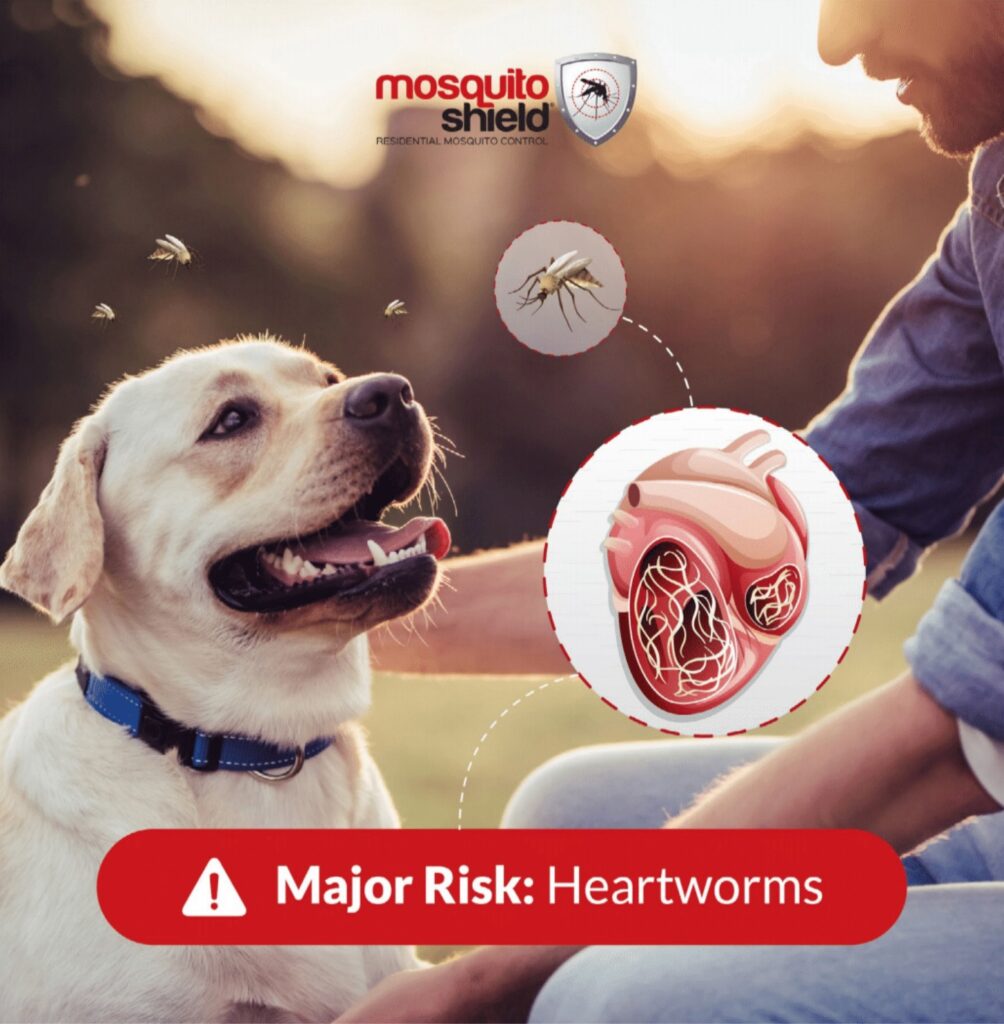
  • Transmission Mechanism: A mosquito bites an infected animal (such as a coyote, fox, or untreated dog) and ingests microfilariae (microscopic heartworm larvae). Inside the mosquito, the larvae mature into an infective stage over two to three weeks. When the mosquito bites a new host, the larvae are deposited on the skin and burrow into the bloodstream.
  • Physiological Impact: Over roughly nine months, the larvae migrate to the right ventricle of the heart and the pulmonary arteries, growing up to 16 inches in length. This causes severe cardiovascular and respiratory compromise.
  • The Silent Threat: Early stages of heartworm infection show zero clinical symptoms. By the time a pet exhibits coughing, lethargy, or weight loss, the cardiopulmonary damage is often advanced. Furthermore, while there are treatment protocols for dogs, there is currently no approved treatment for heartworm in cats, making prevention absolute.

3 easy steps to backyard bliss

Win the backyard battle this year.

    Do you agree to receive text messages from Mosquito Shield? Message frequency may vary. Standard messaging and data rates apply. Text STOP to opt-out at any time. Text HELP for support or contact us. Privacy Policy/TOS.
    Yes, I agree to receive text messages from Mosquito Shield.
    No, I do not want to receive text messages from Mosquito Shield.

    See our Privacy Policy/TOS for details on how we handle your information.

    1. 1

      Request Your Free Quote

      We’re out to kill mosquitoes, not your budget. We’ll be upfront about all costs, and you’ll know exactly what payments will look like before you start. Speak to one of our professionals today about getting a quote for your property.
    2. 2

      Schedule Your Service

      Once you’ve received a quote, you can move forward and begin seeing a difference with our services. Any mosquitoes in the area will be killed on contact and a barrier created to deter new mosquitoes from coming in. It takes less than 48 hours to notice a difference.
    3. 3

      Get Back Outside

      You no longer have to wonder what life would be like without mosquitoes. Go back to enjoying any and all outdoor activities without unwanted guests. Taking care of mosquitoes on your property has never been easier.
    Ready To Get Started?
    Buy Now

    Environmental and Behavioral Prevention Strategies

    Effective pet safety relies on an integrated approach: veterinary prophylaxis combined with environmental source reduction.

    Veterinary Protocols

    Because mosquitoes regularly bypass physical barriers to enter homes, indoor pets are not immune to vector bites.

    • Year-Round Preventatives: The American Heartworm Society and local New Jersey veterinarians recommend year-round administration of FDA-approved heartworm preventatives. Due to the shifting climate and the ability of mosquitoes to survive in microclimates (like basements and garages), seasonal dosing leaves pets vulnerable.
    • Annual Testing: Because no preventative is 100% effective (often due to missed doses or regurgitation), annual blood testing is required to ensure pets remain free of microfilariae.

    Environmental Source Reduction

    Mosquitoes require stagnant water to breed. Reducing breeding sites disrupts their life cycle on a localized level.

    • Eliminate Standing Water: Routinely empty and scrub outdoor pet water bowls, birdbaths, plant saucers, and kiddie pools at least once a week.
    • Clear Debris: Maintain gutters and downspouts. Leaf litter and organic debris trap moisture, creating ideal microhabitats for the Asian Tiger Mosquito.
    • Landscape Management: Keep grass mowed and thin out dense, overgrown shrubbery where adult mosquitoes rest during the heat of the day.

    Exposure Reduction

    • Timing Outdoor Activity: While the Asian Tiger mosquito bites during the day, many local species are most active at dawn and dusk. Limiting prolonged outdoor exposure for pets during these twilight hours reduces bite risk.
    • Structural Integrity: Ensure all window and door screens are free of tears or gaps to prevent the Northern House Mosquito from entering the home during the evening.
    • Pet-Specific Repellents: Never apply human insect repellents (especially those containing DEET) to pets, as they are highly toxic when ingested during grooming. Consult a veterinarian for pet-safe, species-specific topical repellents if additional protection is required.
    Landscaping tips hero image Mosquito shield Southeastern PA mobile version

    Frequently Asked Questions

    01. What other insects will this affect?
    We use a control product so other insects present when and where we spray may be impacted.

    However, our formula was specifically engineered for mosquitoes so it won’t repel any other insects as it does mosquitoes.
    02. Will your product work after storms?
    Yes, we have specifically engineered our formula to outlast storms. With a special polymer layer that provides weather resistance, our formula will remain effective.
    03. Is there any environment you cannot treat?
    Yes, there are some areas we won’t spray to avoid the surrounding environments. Pools, natural water sources, vegetable gardens, and artificial water sources complete the list.

    Because water could easily spread the insecticides, we never directly apply our product to it. However, the rest of the property can still be sprayed and it will drastically reduce the population of mosquitoes.
    04. Does this product work on all mosquitoes and ticks ?
    Yes, we target aspects of mosquitoes and ticks that don’t change from species to species.

    The killing and repelling aspects of our product will work on any species of mosquitoes and ticks .
    05. What about my children and pets?
    Pets and children should be inside during each application. However, they can re-enter the property once the product has dried, roughly 10-15 minutes. At that point, there are no restrictions until the next application.
    06. When can I start to see the effects?
    Every yard is different but you should notice a dramatic reduction within 24-48 hours of the initial spray.

    With each subsequent treatment, the results continue to improve, allowing you to enjoy time outside without being chased in by swarms of mosquitoes.
    07. Why do we see more mosquitoes after it has rained?
    Mosquitoes are more abundant after it rains because standing water is where they breed.

    Adult, female mosquitoes will lay their eggs in water. Once fully submerged, the countdown begins and the eggs can hatch in as little as a few days.

    Shield Your Yard Now