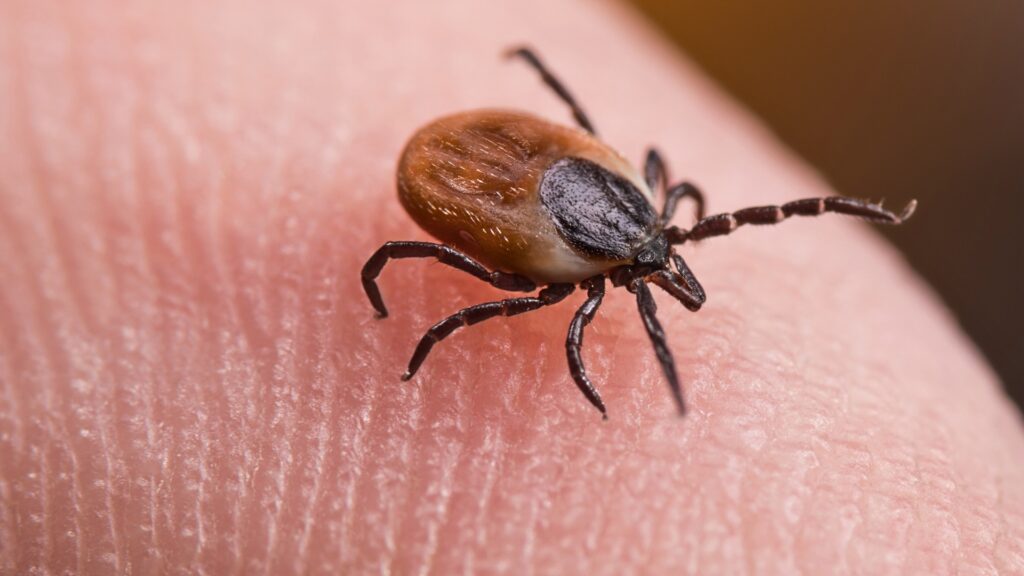
Tick abundance and human-vector contact across greater Austin are driven by specific regional factors:
The Ashe Juniper and Oak Interface: Deciduous leaf litter under live oaks and cedar canopies traps ground-level humidity, shielding ticks from lethal dehydration during periods of summer drought.
Ungulate and Wildlife Densities: Suburban development into the Hill Country has created an extensive greenbelt network supporting abundant white-tailed deer (Odocoileus virginianus), raccoons, Virginia opossums, and coyotes, which serve as transport and reproductive hosts for ticks.
Karst Topography and Greenbelt Recreation: Austin’s park systems and urban greenbelts bring hikers, trail runners, and domestic dogs into frequent direct contact with brushy transition zones where ticks actively quest.

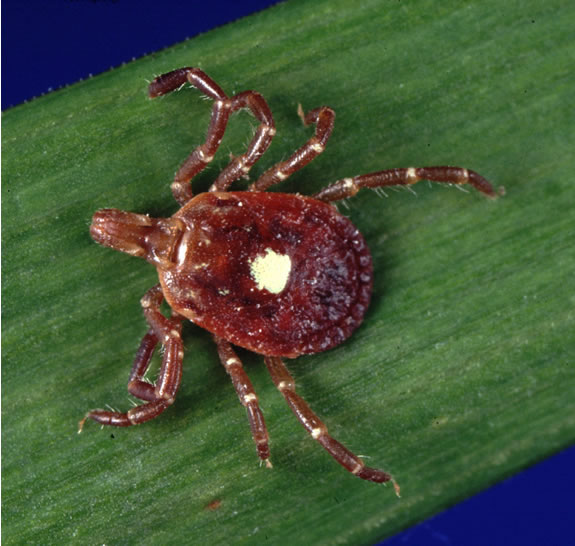
Morphology & Recognition: Reddish-brown, medium-sized tick. The adult female displays a prominent, silvery-white iridescent spot on the center of her dorsal shield (scutum), while the male exhibits subtle pale festoon markings.
Behavior & Habitat: The most prevalent, aggressive, and frequently encountered human-biting tick across Central Texas. Rather than relying solely on passive questing, Lone Star ticks exhibit active hunting behavior—detecting host carbon dioxide, thermal radiation, and vibration to pursue hosts. They thrive in hardwood hammocks, dense juniper scrub, and overgrown residential borders. All three motile stages (larva, nymph, adult) bite humans aggressively. In late summer, dense clusters of larvae (“seed ticks”) hatch in leaf litter and can swarm hosts in large numbers.
Pathogen Association: Primary vector of Ehrlichia chaffeensis and Ehrlichia ewingii (human monocytic ehrlichiosis), Southern Tick-Associated Rash Illness (STARI), and Francisella tularensis (tularemia). Bites from this species are also the established trigger for alpha-gal syndrome (AGS), an acquired red meat allergy.
Morphology & Recognition: Narrow, uniformly reddish-brown body lacking ornamental markings, distinguished by a hexagonal basis capituli behind the capitulum.
Behavior & Habitat: A highly adaptable species uniquely suited to indoor and domestic structures. While other ticks require high outdoor relative humidity to survive, the brown dog tick can complete its entire lifecycle inside residential homes, boarding facilities, dog runs, and veterinary clinics. Though canines are its preferred primary host, heavy structural infestations often lead to opportunistic bites on human occupants.
Pathogen Association: Vector of canine ehrlichiosis (Ehrlichia canis), canine babesiosis, and in localized high-density environments, Rickettsia rickettsii (the causative agent of Rocky Mountain Spotted Fever).
Morphology & Recognition: Compact tick with a dark black scutum, black legs, and a contrasting reddish-orange posterior abdomen in unengorged females.
Behavior & Habitat: Found primarily in moist forest pockets, river basins, and shaded ravine bottoms in Travis County. In Texas, immature stages feed primarily on skinks and other small reptiles rather than white-footed mice. Because reptilian blood proteins do not harbor the Lyme disease spirochete (Borrelia burgdorferi) effectively, transmission rates in Central Texas remain markedly lower than in the Northeast. Adults quest primarily during the cooler months from late fall to early spring.
Pathogen Association: Competent vector for Borrelia burgdorferi (Lyme disease) and Anaplasma phagocytophilum (anaplasmosis).